
Lifestyle
Tesla Model 3, S become first EVs to complete One Lap of America rally event

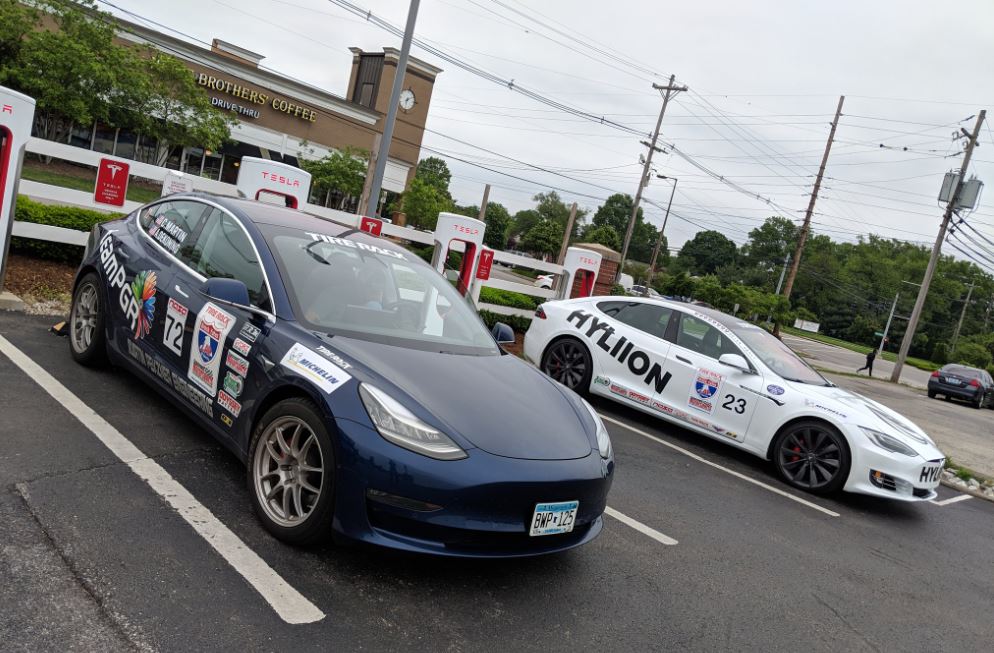
A Tesla Model 3 Performance and Model S P100D became the first all-electric vehicles to compete in the Tire Rack One Lap America road rally event, completing 18 track races at 9 locations for a total of about 3,500 miles over seven days. Thanks to Tesla’s vast Supercharger Network, the built-in performance features of their cars, and some great planning, both teams finished successfully and even took home a few wins. This year’s event took place from May 3rd through the 11th, marking its 36th year running.
Driving the Model 3 Performance was Team Panel Gap Racing (PGR) with Andrew Dekoning and Chad Martin behind the wheel. Andrew previously took part in the 2006 One Lap driving a Mazda RX-7, and as a veteran of the event and Tesla enthusiast, he knew there were advantages the Model 3 had that would make it competitive against other gas-powered vehicles.
“We had a few things that made us think this year was the year for a Tesla. #1 is that no one has ever completed the One Lap in an electric car, and we thought with the introduction of the Model 3 that it was possible,” he told us while the team was on the road. “With a performance model and Track Mode, it would actually be a pretty good car. This event is part road rally, part transit, and part on-track competition – the best cars excel at all three.”

The Tire Rack One Lap of America road rally event’s history dates back to the Cannonball Run, a not-quite-legal American highway race from New York City to Redondo Beach, California. It was created by Brock Yates, former senior editor of Car and Driver Magazine, to prove the point that competent, well-trained drivers could safely compete on highways while having a good time reminiscent of barnstorm piloting days. After a few revisions, One Lap was eventually organized into the format it has today. Drivers travel to nine places located in several different states to compete at 18 timed track events including time trials, skid pads, and drag races.
To meet their battery power needs, Team PGR used 27 Superchargers and 22 plug-ins either at the track or hotels they stayed at for a total of 1,500 kWh used to complete the event. Along with the availability of Superchargers and other power sources, the Model 3’s Track Mode gave the team a competitive edge.
“Without Track Mode we likely wouldn’t have made the attempt,” Andrew explained. “We had faith from the development story with Randy Pobst that they had the feature dialed in fairly well…Track Mode (and AWD) allow you to turn with the accelerator which is a fun new challenge and very fast when done right.”
Only minimal aftermarket swaps were made to Team PGR’s midsize sedan before taking on the One Lap challenge to keep the car within “Stock” class requirements. They upgraded the Model 3’s front brake pads and rotors with Racing Brake parts, used racing brake fluid, and opted for Michelin Pilot Sport 4S tires. Aftermarket rear brake pads weren’t available, however, and the stock versions used on the car melted during one of the time trials.

One other hiccup reported was the loss of cruise control, Autopilot, the speed limit display, and automatic wipers about two-thirds of the way into the trip, but those issues only impacted convenience. Tesla’s support service indicated a software bug may have caused the losses, and the issue was fixed after completion of the One Lap with a system reboot.
The tweaks and detailed planning paid off in the end for Andrew and Chad. Team PGR finished first in the Alternative Fuel category, 2nd in the Stock Touring class, and 17th in the One Lap overall out of 77 vehicles competing.
As Tesla enthusiasts, there was more than winning with an all-electric car that motivated Team PGR’s decision to join One Lap this year, namely in sharing everything that comes with the Tesla ownership experience.
“We wanted to show a whole new set of people (enthusiasts) that this was possible, and that the car was very good. At least half the field didn’t know that Superchargers were as prevalent as they are, so they didn’t know how we’d make it. They didn’t know about Track Mode, how well the car works to control the power, cornering, braking, etc. That said, there were a number of people who were very excited/interested to see how we did, who know the performance potential of the car, and [were] rooting for us,” Andrew explained.
#teamPGR photo – with our awesome #Tesla #racecar. #Tirerack #GRM #OLOA2019 pic.twitter.com/yW1Urk1oXK
— teamPGR (@team_pgr) May 12, 2019
The Tesla Model S driving team named Hyliion joined the event as a last-minute entrant after their gas-powered vehicle options became unavailable for the One Lap. The father and son team of Thomas and Brian Healy have their own alternative fuel creds aside from racing their 2017 P100D via Hyliion, their semi truck manufacturing company that’s developing a diesel-electric hybrid Class 8 long hauler. The Model S performed well for the team, although the lack of Track Mode’s thermal protections required adjustments to their driving techniques to compensate during timed trials.
Much like Team PGR, the Hyliion drivers were able to take advantage of Tesla’s extensive Supercharger network to participate successfully in the One Lap and they finished 34th overall.
“The most surprising thing was the abundance of Superchargers that are out there in order to keep the car charged. We weren’t sure going into the event how manageable it was going to be, getting from one track to the next, and being able to do it in the allotted time… Tesla’s done a great job of getting these Superchargers located around the US, where finding a destination to stop at and charge up for 45 minutes is a really feasible thing,” the team told CNET’s Roadshow in comments about the event.

As for Andrew and Chad, they plan to participate in future One Lap events with other Tesla vehicles and also expect more of the all-electric cars to meet them on the tracks.
“Because we are newer to running this car on track, and the car is new overall, we believe it has a lot more potential! We are already scheming about how to improve the car and how to find someone with one of the first [Next Generation] Roadsters when it is released so we can ‘borrow’ it for the One Lap…I think by completing the events we will go a ways toward changing some minds toward electric cars in the performance driving community and it will not surprise me if there’s 5 Model 3’s here next year,” Andrew concluded enthusiastically.
For more about TeamPGR, watch their video below with some updates and highlights from the One Lap of America 2019.


Elon Musk
The Boring Company clears final Nashville hurdle: Music City loop is full speed ahead
The Boring Company has cleared its final Nashville hurdles, putting the Music City Loop on track for 2026.

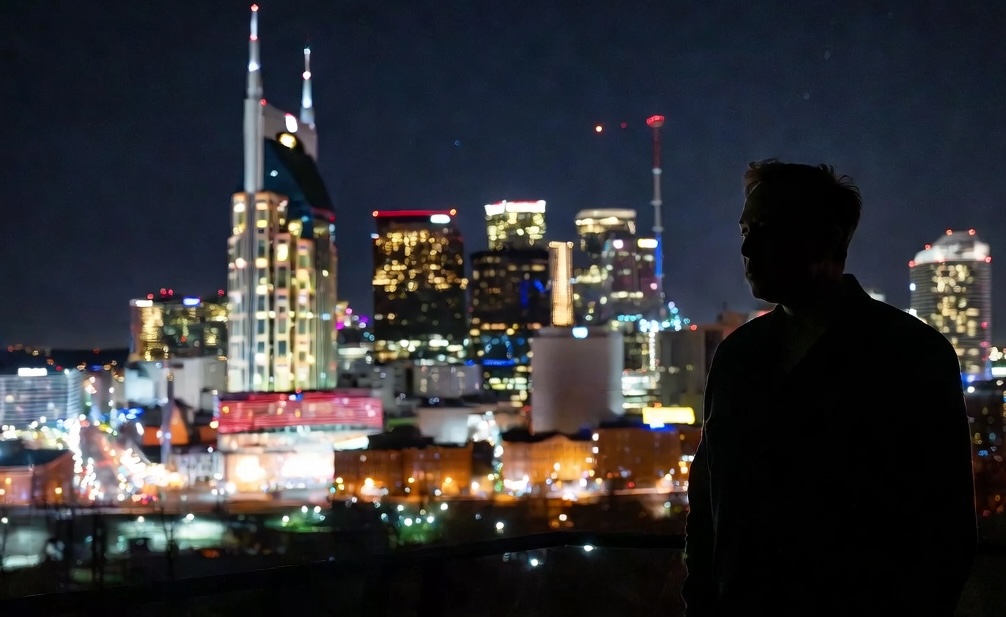
The Boring Company has cleared one of its most significant regulatory milestones yet, securing a key easement from the Music City Center in Nashville just days ago, the latest in a series of approvals that have pushed the Music City Loop project firmly into construction reality.
On March 24, 2026, the Convention Center Authority voted to grant The Boring Company access to an easement along the west side of the Music City Center property, allowing tunneling beneath the privately owned venue. The move follows a unanimous 7-0 vote by the Metro Nashville Airport Authority on February 18, and a joint state and federal approval from the Tennessee Department of Transportation and the Federal Highway Administration on February 25. Together, these green lights have cleared the path for a roughly 10-mile underground tunnel connecting downtown Nashville to Nashville International Airport, with potential extensions into midtown along West End Avenue.
Music City Loop could highlight The Boring Company’s real disruption
Nashville was selected by The Boring Company largely because of its rapid population growth and the strain that growth has placed on surface infrastructure. Traffic has become a persistent problem for residents, convention visitors, and airport travelers alike. The Music City Loop promises an approximately 8-minute underground transit time between downtown and the Nashville International Airport (BNA), removing thousands of vehicles from surface roads daily while operating as a fully electric, zero-emissions system at no cost to taxpayers.
The project fits squarely within a broader vision Musk has championed for years. In responding to a breakdown of the Loop’s construction costs, Musk posted on X: “Tunnels are so underrated.” The comment reflected a longstanding belief that underground transit represents one of the most cost-effective and scalable infrastructure solutions available. The Boring Company has claimed it can build 13 miles of twin tunnels in Nashville for between $240 million and $300 million total, a fraction of what comparable projects cost elsewhere in the country.
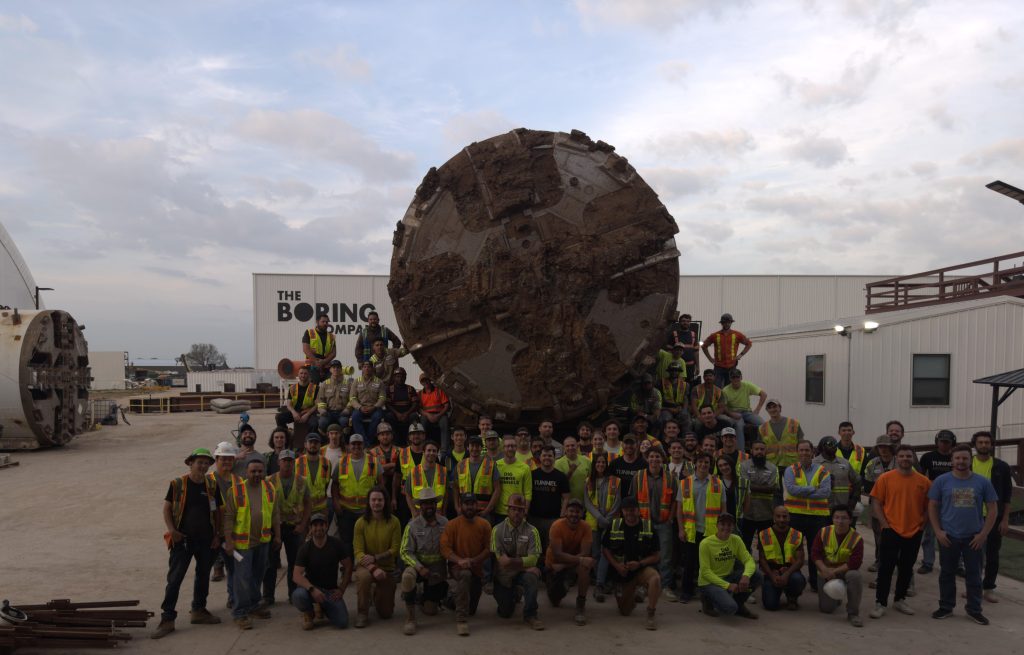
Image Credit: The Boring Company/Twitter
The Las Vegas Loop, The Boring Company’s first operational system, has served as a proof of concept. During the CONEXPO trade show in March 2026, the Vegas Loop transported approximately 82,000 passengers over five days at the Las Vegas Convention Center, demonstrating the system’s capacity during large-scale events. Nashville draws millions of convention visitors and tourists each year, and local business leaders have pointed to that same capacity as a major draw for supporting the project.
The Music City Loop was first announced in July 2025. Construction began within hours of the February 25 state approval, with The Boring Company’s Prufrock tunneling machine already in the ground the same evening. The first operational segment is targeted for late 2026, with the full route expected to be complete by 2029. The project represents one of the largest privately funded infrastructure efforts currently underway in the United States.
Elon Musk
Elon Musk’s $10 Trillion robot: Inside Tesla’s push to mass produce Optimus
Tesla’s surging Optimus job listings reveal a company sprinting from prototype to one million robot production.
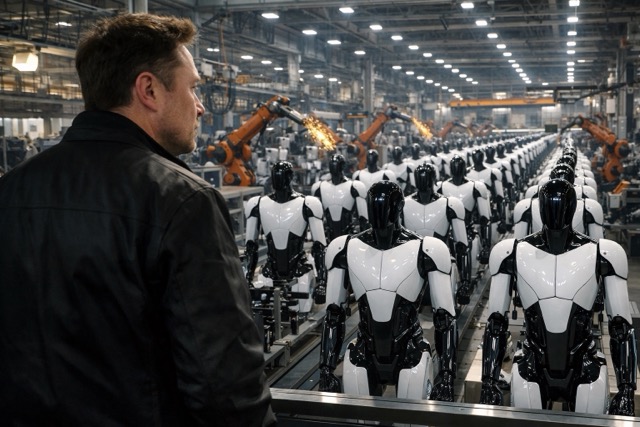
Tesla is accelerating its push to bring the Optimus humanoid robot to high volume production, and its recent job listings tells the story as clearly as any earnings call.
With well over 100 Optimus related job openings now posted across its U.S. facilities, Tesla is signaling a critical pivot for the program, moving it from a captivating tech demo to a serious manufacturing endeavor. Roles span the full spectrum of the product lifecycle, from Robotics Software Engineers and Manufacturing Engineers to Mechanical Integration Engineers and AI Engineers focused on world modeling and video generation. One active listing for a Software Engineer on the Optimus team asks candidates to build scalable and reliable data pipelines for Optimus manufacturing lines and develop automation tools that accelerate analysis and visualization for mass manufacturing.
Tesla is racing toward a one million unit annual production target. The clearest signal yet that Tesla is treating Optimus as its primary business came on January 28, 2026, during the company’s Q4 2025 earnings call. Musk announced that Tesla is ending production of the Model S and Model X, and will repurpose those lines at its Fremont, California factory to build Optimus humanoid robots.
A production intent prototype of Optimus Version 3 is planned to be ready in early 2026, after which Tesla intends to build a one million unit production line with a targeted production start by the end of 2026. To support that ramp, Tesla broke ground on a massive new Optimus manufacturing facility at Gigafactory Texas in late 2025, with ambitions to eventually reach 10 million units per year.
Tesla Giga Texas to feature massive Optimus V4 production line
The business case for scaling this aggressively is rooted in labor economics. Musk has stated that “Optimus has the potential to be the biggest product of all time,” reasoning that if Tesla can produce capable humanoid robots at scale and reasonable cost, every task currently performed by human labor becomes a potential application. In a separate statement, Musk framed Optimus’s long term importance even more bluntly, saying it could surpass Tesla’s vehicle business in scale with the potential to generate $10 trillion in revenue.
The industries Tesla is targeting first are those most burdened by repetitive physical labor. Early applications include manufacturing assembly, material handling and quality inspection, as well as logistics tasks like loading, unloading, sorting, and transporting goods in warehouses and distribution centers. Longer term, Tesla’s vision is for Optimus to penetrate household, medical, and logistics scenarios at the scale of a smartphone rollout.
Elon Musk
Elon Musk’s Boring Co. Tunnel Vision Challenge ends with a surprise for Louisiana, Maryland and Dallas
The Boring Company stunned three cities today, awarding New Orleans, Baltimore, and Dallas free underground Loop tunnels.
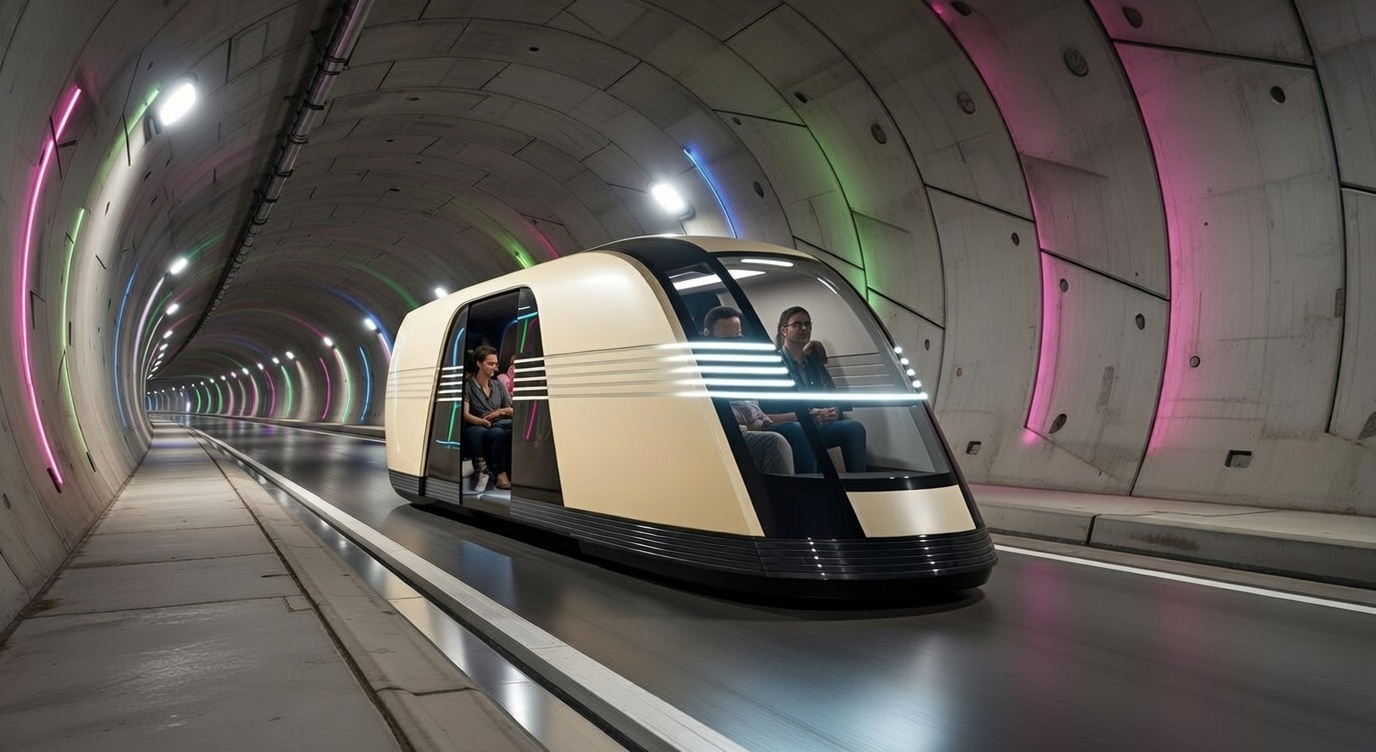
Elon Musk’s The Boring Company (TBC) announced today that it is building free underground Loop tunnels in three American cities: New Orleans, Louisiana; Baltimore, Maryland; and Dallas, Texas. The company had promised one winner when it launched the Tunnel Vision Challenge in January. After receiving 487 submissions, it selected three, committing to fund and construct all of them pending a feasibility review, entirely at its own expense. For a company that has faced years of skepticism over the gap between its promises and its delivered projects, choosing to expand its commitment rather than narrow it is a notable shift in both scale and accountability.
All three projects will now enter a rigorous, fully funded diligence phase that includes meetings with elected officials, regulators, community and business leaders, geotechnical borings, and a complete investigation of subsurface utilities and infrastructure. TBC confirmed that all costs associated with this diligence process are 100% funded by the company. If all three projects pass feasibility, all three get built. If only one clears the bar, that one gets built. The company’s willingness to fund the due diligence regardless of outcome removes one of the most common early-stage barriers that kills promising infrastructure proposals before they leave a spreadsheet.
Beyond the three winners, TBC announced it will continue working with two additional entrants it found compelling enough to pursue independently: the Hendersonville Utility Tunnel in Hendersonville, Tennessee, and the Morgan’s Wonderland Tunnel in San Antonio, Texas, which would notably serve one of the nation’s premier theme parks built specifically for guests with special needs.
The challenge also coincides with TBC’s most active construction period to date. The company recently began drilling on the Music City Loop near the Tennessee State Capitol in Nashville, and in February it broke ground on a Loop in Dubai. Musk has long argued that the fundamental problem with urban infrastructure is cost and bureaucratic inertia, not engineering. “The key to solving traffic is making going 3D either up or down,” he said in 2018, a conviction now reflected in a company structure built to absorb the financial risk that typically stalls public projects for years.
Music City Loop could highlight The Boring Company’s real disruption
The Tunnel Vision Challenge’s most underappreciated element may be what it produced beyond three winners. Submissions came from individuals, companies, and governments across states including Alaska, Arkansas, Colorado, Kansas, Louisiana, Maryland, New York, and Texas, as well as from international entrants. Musk captured the underlying logic years ago when he said, “Traffic is driving me nuts. I’m going to build a tunnel boring machine and just start digging.” Today, three American cities are counting on exactly that.
Tunnel Vision Challenge results!
We’ve been overwhelmed with the amazing submissions…so we are announcing three winners!
The Thrilling Three are:
– NOLA Loop (New Orleans, LA)
– Ravens Loop (Baltimore, MD)
– University Hills Loop (Dallas, TX)What happens next? TBC and the… https://t.co/cY2ULftfiK
— The Boring Company (@boringcompany) March 24, 2026

Tesla FSD mocks BMW human driver: Saves pedestrian from near miss

Tesla Robotaxi gets a small but significant change

Tesla makes latest announcement on Model S and Model X

Elon Musk says Tesla is developing a new vehicle: ‘Way cooler than a minivan’

Elon Musk launches TERAFAB: The $25B Tesla-SpaceXAI chip factory that will rewire the AI industry


