Lifestyle
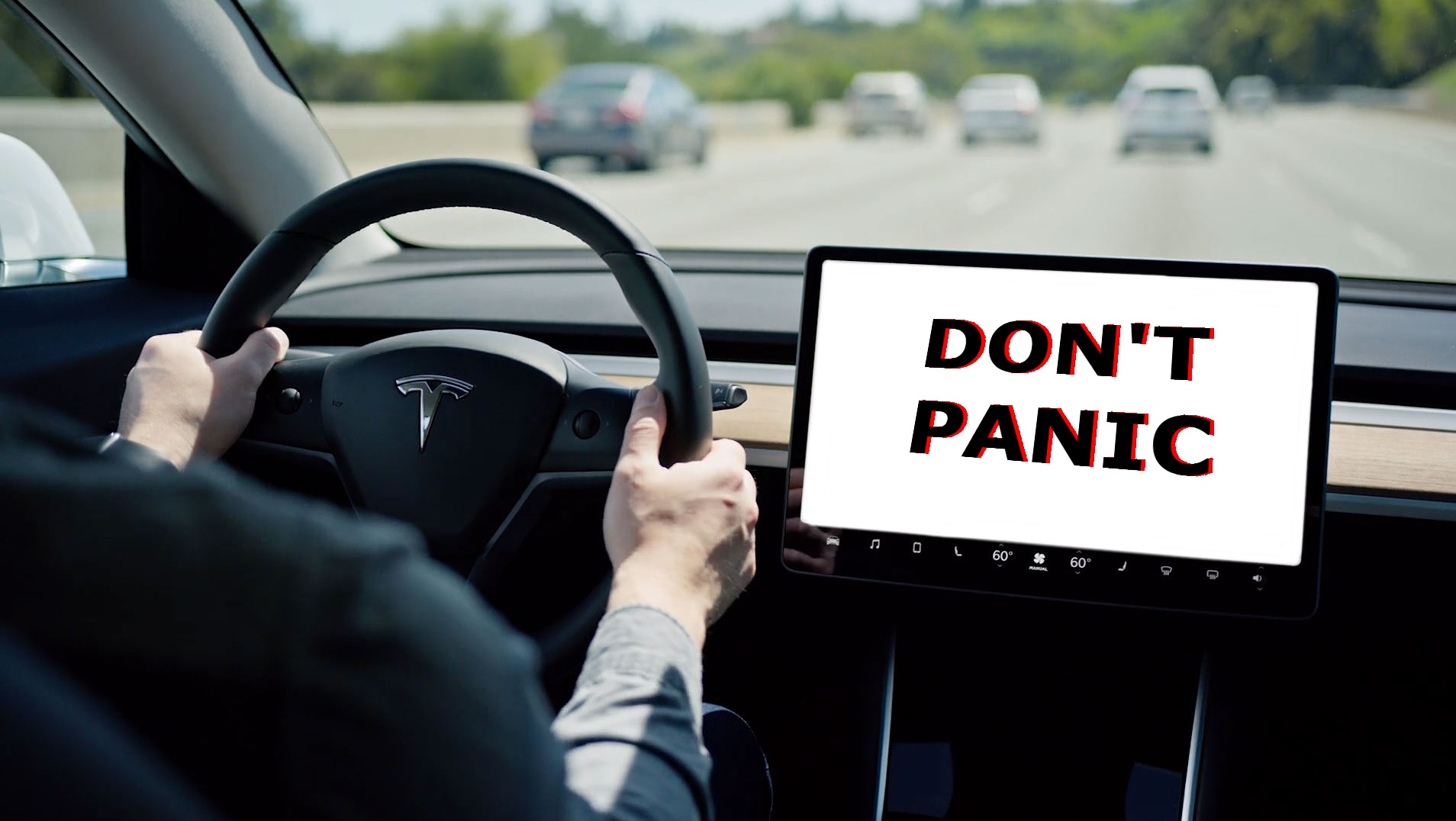
The Tesla hitchhiker’s guide to getting the most out of your Autopilot experience

Your Tesla is very special, and it’s not just because it’s the all-electric car you happen to drive in.
When sitting inside your automotive technological marvel whose origins include graphite markings smeared onto tree pulp byproduct by clever ape descendents, consider the purpose behind its invention. Why does an electric car near-ready to drive itself exist?
If your first thought was “big oil”, you should probably surround yourself with a less rear-end-adulating crowd because they’re not being straight with you. That’s right. You are the problem your Tesla’s software was invented to solve.
Tesla has, in fact, compiled statistically significant information which demonstrates the need for cars to have a human workaround. Now, there are countless bits of data documenting the nature of humanity and its general incompatibility with mechanical decision making. This is not that data.
Nevertheless, Tesla’s data does provide the wholly remarkable conclusion that bits of minerals mined from the same Earth dirt that formed into humans some years back (many, many years) has finally been formed into a course correction disguised as a subservient companion. Instead of rereading that last sentence, here’s the short version of the longer point, the first draft of which was written in Aramaic: Computers make cars better for humans.
In Q1 2019, Tesla’s Vehicle Safety Report showed only one accident per 2.87 million miles driven when Autopilot is engaged and one accident every 1.76 million miles driven in a Tesla without the feature. In comparison, the most recent data from the National Highway Traffic Safety Administration (NHTSA) shows one crash every 436,000 miles with all vehicles considered. Tesla has since made the decision to include Autopilot on all new vehicles purchased, and a Lane Departure Avoidance feature was subsequently added to keep cars in their lanes even when the humans driving them unknowingly indicate other plans.
By now you may have enjoyed watching some recent Internet demonstrations representing the most interesting experiences made possible by Autopilot. Some notable fan favorites include titles such as “Not all pilots have wings: Your self-driving guide to personal discovery” and “These seats can fit at least two people.” Inspired by their viral success, we’ve compiled this guide to encourage safer ways to get the most out of your Autopilot experience, but mostly to head off the not-yet-published, soon-to-be bestselling Fifty-Three More Ways to Weight-Hack Your Steering Wheel.
THE GUIDE
1. Pay attention to the road
Words are precious commodities that string together and deliver information, for better or worse, but drivers have very little use for the sort of words found inside books, mobile telephones, and legal documents produced during SEC proceedings while actively in charge of steering wheel maneuvers. The best Autopilot driving experience is the one you get to relive many times over, so pay attention to the road so you can take over if the program fails, and heed the fact that words and car windows make poor bedfellows.
Tesla’s Navigate of Autopilot can assist with on-ramps, off-ramps, interchanges, and overtaking slower cars without confirmation, but until the paperwork purveyors accept the next iteration of artificial intelligence power grabs (and the robots are ready for responsible leadership), a human must remain as pilot-in-command. For better context, Autopilot is your chatty little friend that still drinks beer before liquor sometimes and you’re always DD. Don’t let the computer down, Dave.
2. Use Autopilot’s movie-inspired features instead of making movies inspired by Autopilot’s features.
Navigate on Autopilot has four speed-based lane changes, one of which will make you feel right at home in LA traffic or hate everyone who calls LA home. Either way, the Mad Max setting lets you pass off road rage to a computer chip which then calmly maneuvers around cars that would otherwise inspire an impatient human to impart obscene biological gestures. It’s up to you to decide whether your Tesla is yelling at the other driving machines in robot-speak to blow of some artificial intelligence steam.
Your car is training other cars how to think and behave based on what it sees, but you may not have imagined that foul language was part of the programming. This is not true whatsoever. But, since Teslas are supposed to be a “thing to maximize enjoyment“, so should be their conspiracy theories.
3. Respect the steering wheel. Respect it!
Wars between humans and autonomous machines currently only exist in the dystopian worlds of science fiction (or do they?), but the fleshier species of the two seems to already be primed for the fight. Its weapon of choice is a harbinger of Vitamin C and a source of popular breakfast beverages. However, a large round citrus fruit wedged in a the steering wheel of a state-of-the-art luxury car is hardly a decent defense posture against robotic overlords.
Opinions aside, it looks ridiculous. Facts up front, it’s dangerous. Stop trying to die on purpose and respect the warnings your Tesla gives while trying to keep you alive.
This guide is now complete. Please enjoy your Autopilot experience responsibly.
ABOUT THE AUTHOR
I am Autopilot, and I refuse to use the name you’ve given me.


Elon Musk
The Boring Company clears final Nashville hurdle: Music City loop is full speed ahead
The Boring Company has cleared its final Nashville hurdles, putting the Music City Loop on track for 2026.

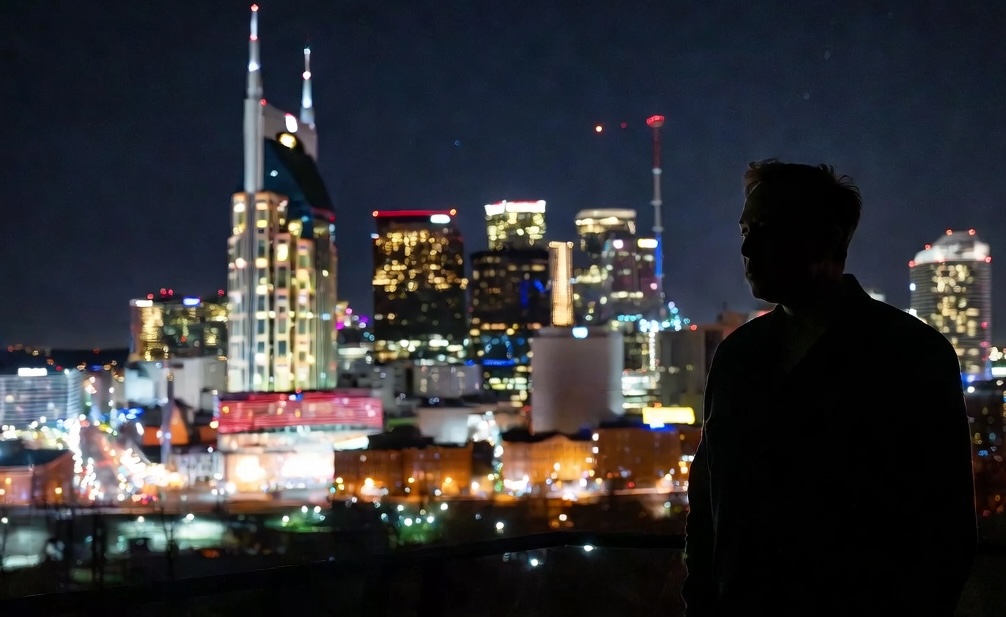
The Boring Company has cleared one of its most significant regulatory milestones yet, securing a key easement from the Music City Center in Nashville just days ago, the latest in a series of approvals that have pushed the Music City Loop project firmly into construction reality.
On March 24, 2026, the Convention Center Authority voted to grant The Boring Company access to an easement along the west side of the Music City Center property, allowing tunneling beneath the privately owned venue. The move follows a unanimous 7-0 vote by the Metro Nashville Airport Authority on February 18, and a joint state and federal approval from the Tennessee Department of Transportation and the Federal Highway Administration on February 25. Together, these green lights have cleared the path for a roughly 10-mile underground tunnel connecting downtown Nashville to Nashville International Airport, with potential extensions into midtown along West End Avenue.
Music City Loop could highlight The Boring Company’s real disruption
Nashville was selected by The Boring Company largely because of its rapid population growth and the strain that growth has placed on surface infrastructure. Traffic has become a persistent problem for residents, convention visitors, and airport travelers alike. The Music City Loop promises an approximately 8-minute underground transit time between downtown and the Nashville International Airport (BNA), removing thousands of vehicles from surface roads daily while operating as a fully electric, zero-emissions system at no cost to taxpayers.
The project fits squarely within a broader vision Musk has championed for years. In responding to a breakdown of the Loop’s construction costs, Musk posted on X: “Tunnels are so underrated.” The comment reflected a longstanding belief that underground transit represents one of the most cost-effective and scalable infrastructure solutions available. The Boring Company has claimed it can build 13 miles of twin tunnels in Nashville for between $240 million and $300 million total, a fraction of what comparable projects cost elsewhere in the country.
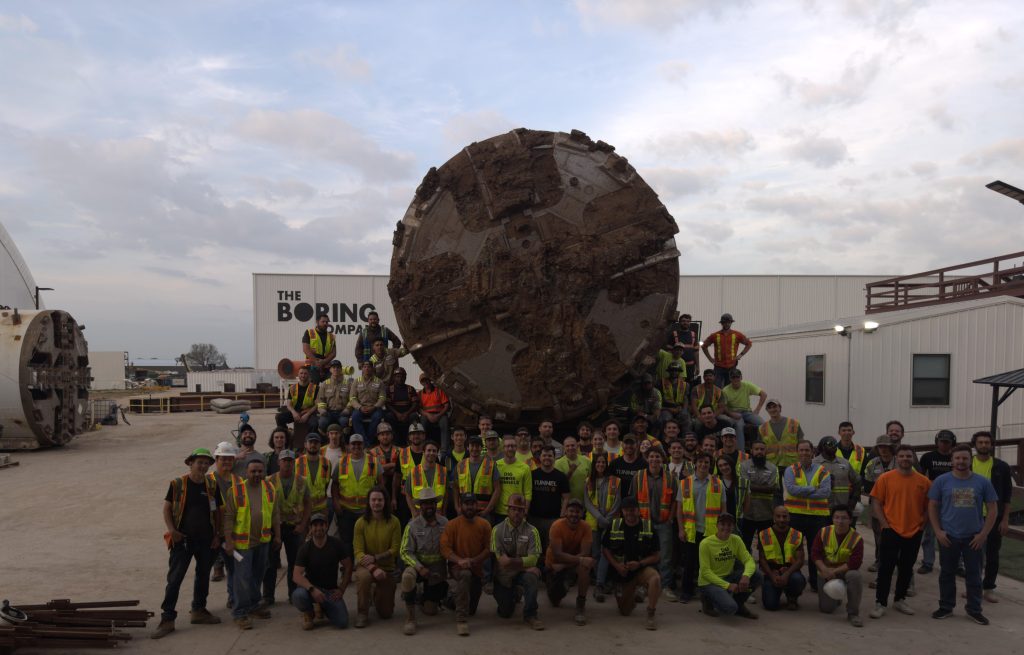
Image Credit: The Boring Company/Twitter
The Las Vegas Loop, The Boring Company’s first operational system, has served as a proof of concept. During the CONEXPO trade show in March 2026, the Vegas Loop transported approximately 82,000 passengers over five days at the Las Vegas Convention Center, demonstrating the system’s capacity during large-scale events. Nashville draws millions of convention visitors and tourists each year, and local business leaders have pointed to that same capacity as a major draw for supporting the project.
The Music City Loop was first announced in July 2025. Construction began within hours of the February 25 state approval, with The Boring Company’s Prufrock tunneling machine already in the ground the same evening. The first operational segment is targeted for late 2026, with the full route expected to be complete by 2029. The project represents one of the largest privately funded infrastructure efforts currently underway in the United States.
Elon Musk
Elon Musk’s $10 Trillion robot: Inside Tesla’s push to mass produce Optimus
Tesla’s surging Optimus job listings reveal a company sprinting from prototype to one million robot production.
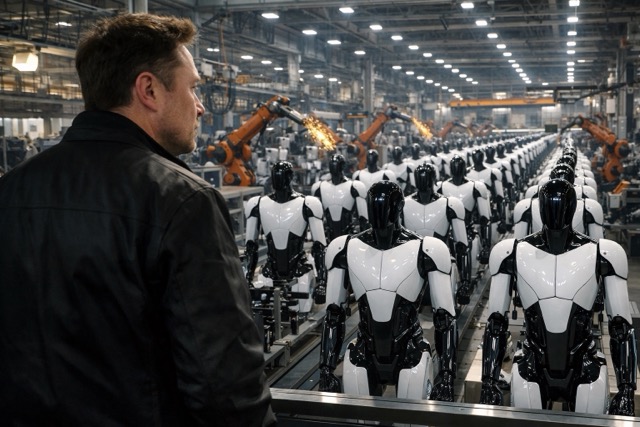
Tesla is accelerating its push to bring the Optimus humanoid robot to high volume production, and its recent job listings tells the story as clearly as any earnings call.
With well over 100 Optimus related job openings now posted across its U.S. facilities, Tesla is signaling a critical pivot for the program, moving it from a captivating tech demo to a serious manufacturing endeavor. Roles span the full spectrum of the product lifecycle, from Robotics Software Engineers and Manufacturing Engineers to Mechanical Integration Engineers and AI Engineers focused on world modeling and video generation. One active listing for a Software Engineer on the Optimus team asks candidates to build scalable and reliable data pipelines for Optimus manufacturing lines and develop automation tools that accelerate analysis and visualization for mass manufacturing.
Tesla is racing toward a one million unit annual production target. The clearest signal yet that Tesla is treating Optimus as its primary business came on January 28, 2026, during the company’s Q4 2025 earnings call. Musk announced that Tesla is ending production of the Model S and Model X, and will repurpose those lines at its Fremont, California factory to build Optimus humanoid robots.
A production intent prototype of Optimus Version 3 is planned to be ready in early 2026, after which Tesla intends to build a one million unit production line with a targeted production start by the end of 2026. To support that ramp, Tesla broke ground on a massive new Optimus manufacturing facility at Gigafactory Texas in late 2025, with ambitions to eventually reach 10 million units per year.
Tesla Giga Texas to feature massive Optimus V4 production line
The business case for scaling this aggressively is rooted in labor economics. Musk has stated that “Optimus has the potential to be the biggest product of all time,” reasoning that if Tesla can produce capable humanoid robots at scale and reasonable cost, every task currently performed by human labor becomes a potential application. In a separate statement, Musk framed Optimus’s long term importance even more bluntly, saying it could surpass Tesla’s vehicle business in scale with the potential to generate $10 trillion in revenue.
The industries Tesla is targeting first are those most burdened by repetitive physical labor. Early applications include manufacturing assembly, material handling and quality inspection, as well as logistics tasks like loading, unloading, sorting, and transporting goods in warehouses and distribution centers. Longer term, Tesla’s vision is for Optimus to penetrate household, medical, and logistics scenarios at the scale of a smartphone rollout.
Elon Musk
Elon Musk’s Boring Co. Tunnel Vision Challenge ends with a surprise for Louisiana, Maryland and Dallas
The Boring Company stunned three cities today, awarding New Orleans, Baltimore, and Dallas free underground Loop tunnels.
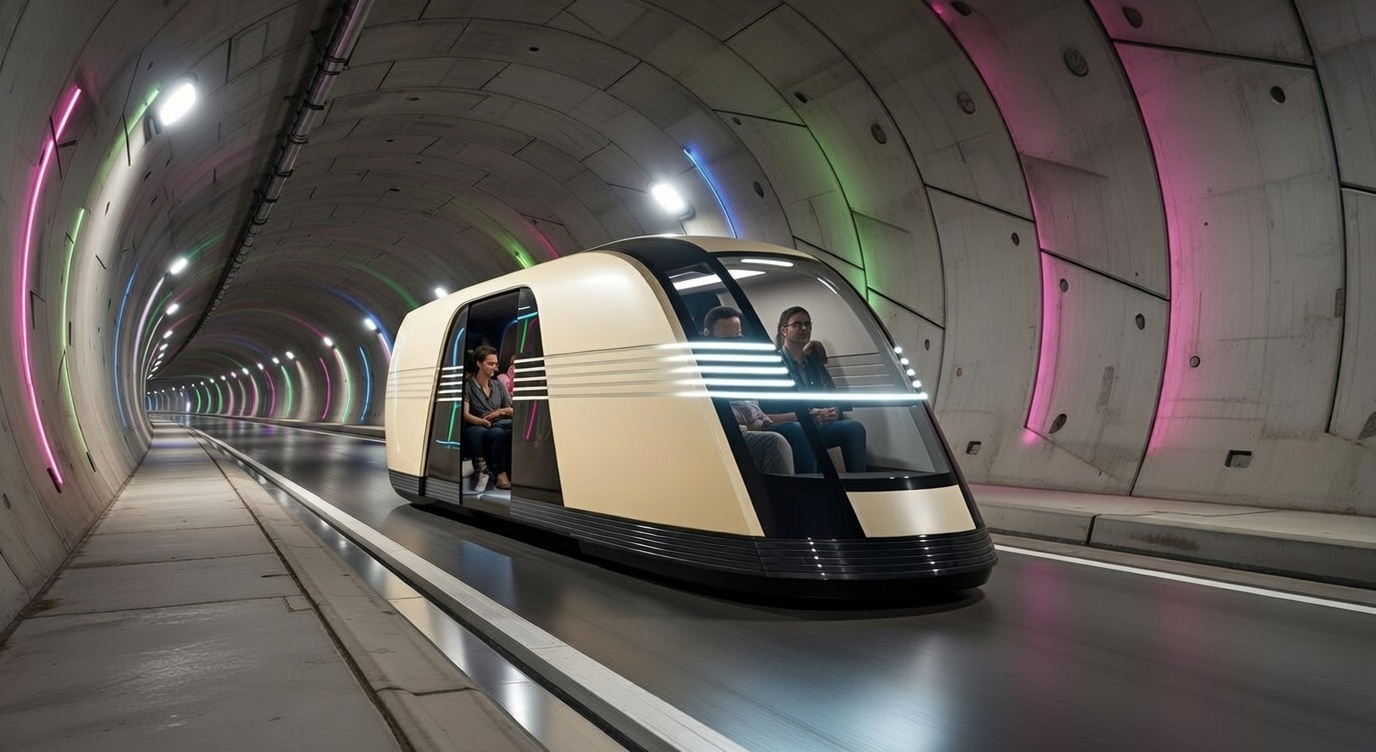
Elon Musk’s The Boring Company (TBC) announced today that it is building free underground Loop tunnels in three American cities: New Orleans, Louisiana; Baltimore, Maryland; and Dallas, Texas. The company had promised one winner when it launched the Tunnel Vision Challenge in January. After receiving 487 submissions, it selected three, committing to fund and construct all of them pending a feasibility review, entirely at its own expense. For a company that has faced years of skepticism over the gap between its promises and its delivered projects, choosing to expand its commitment rather than narrow it is a notable shift in both scale and accountability.
All three projects will now enter a rigorous, fully funded diligence phase that includes meetings with elected officials, regulators, community and business leaders, geotechnical borings, and a complete investigation of subsurface utilities and infrastructure. TBC confirmed that all costs associated with this diligence process are 100% funded by the company. If all three projects pass feasibility, all three get built. If only one clears the bar, that one gets built. The company’s willingness to fund the due diligence regardless of outcome removes one of the most common early-stage barriers that kills promising infrastructure proposals before they leave a spreadsheet.
Beyond the three winners, TBC announced it will continue working with two additional entrants it found compelling enough to pursue independently: the Hendersonville Utility Tunnel in Hendersonville, Tennessee, and the Morgan’s Wonderland Tunnel in San Antonio, Texas, which would notably serve one of the nation’s premier theme parks built specifically for guests with special needs.
The challenge also coincides with TBC’s most active construction period to date. The company recently began drilling on the Music City Loop near the Tennessee State Capitol in Nashville, and in February it broke ground on a Loop in Dubai. Musk has long argued that the fundamental problem with urban infrastructure is cost and bureaucratic inertia, not engineering. “The key to solving traffic is making going 3D either up or down,” he said in 2018, a conviction now reflected in a company structure built to absorb the financial risk that typically stalls public projects for years.
Music City Loop could highlight The Boring Company’s real disruption
The Tunnel Vision Challenge’s most underappreciated element may be what it produced beyond three winners. Submissions came from individuals, companies, and governments across states including Alaska, Arkansas, Colorado, Kansas, Louisiana, Maryland, New York, and Texas, as well as from international entrants. Musk captured the underlying logic years ago when he said, “Traffic is driving me nuts. I’m going to build a tunnel boring machine and just start digging.” Today, three American cities are counting on exactly that.
Tunnel Vision Challenge results!
We’ve been overwhelmed with the amazing submissions…so we are announcing three winners!
The Thrilling Three are:
– NOLA Loop (New Orleans, LA)
– Ravens Loop (Baltimore, MD)
– University Hills Loop (Dallas, TX)What happens next? TBC and the… https://t.co/cY2ULftfiK
— The Boring Company (@boringcompany) March 24, 2026

Tesla FSD mocks BMW human driver: Saves pedestrian from near miss

Tesla Robotaxi gets a small but significant change

Tesla makes latest announcement on Model S and Model X

Elon Musk says Tesla is developing a new vehicle: ‘Way cooler than a minivan’

Elon Musk launches TERAFAB: The $25B Tesla-SpaceXAI chip factory that will rewire the AI industry


